


Both engine types can deliver an exciting off-road experience, but they differ considerably in power delivery, weight, fuel system, maintenance requirements, and riding characteristics.
So, is a 2-stroke or a 4-stroke better?
A 2-stroke dirt bike is generally lighter, mechanically simpler, and more responsive. A 4-stroke dirt bike usually provides smoother power, stronger low-speed torque, more noticeable engine braking, and a more convenient fuel system.
Neither option is automatically better for everyone. The right choice depends on the rider’s age, experience, preferred terrain, maintenance ability, and intended use.
In this guide, we will explain how both engines work, compare the key differences, and help you choose the right dirt bike.
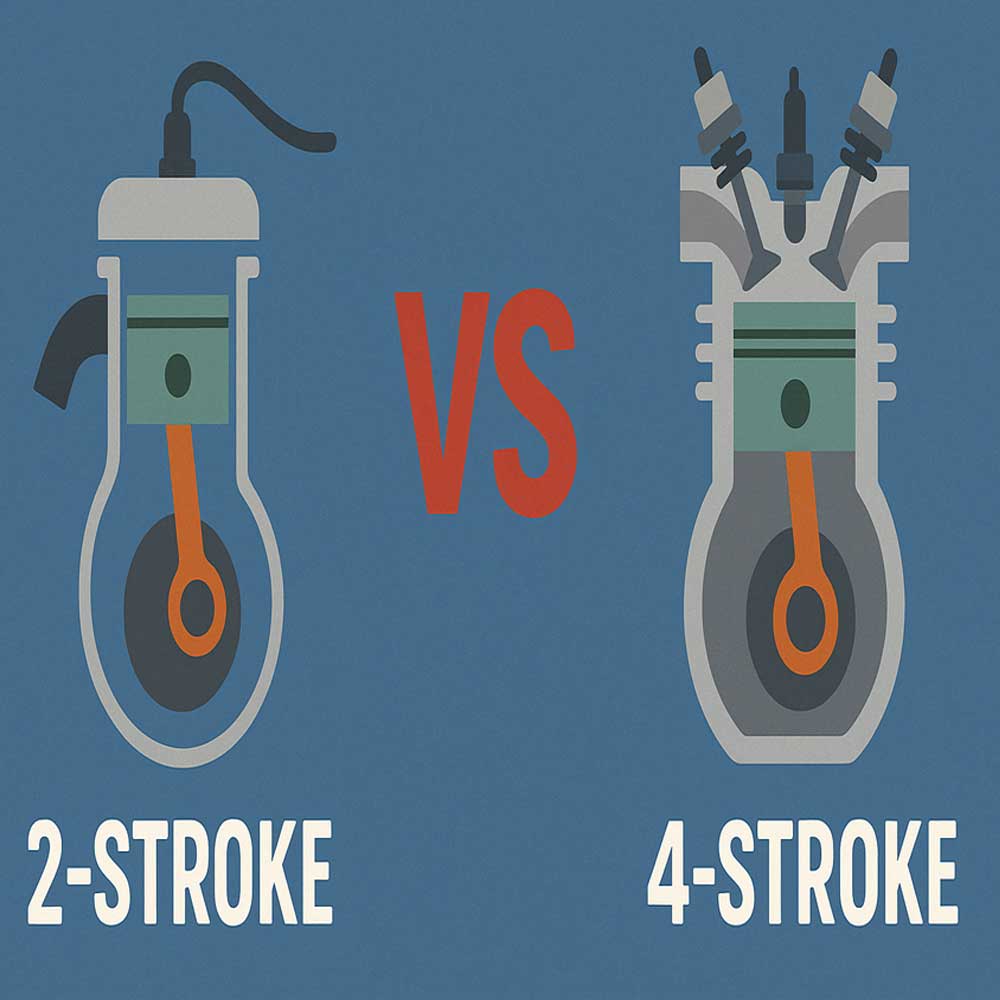
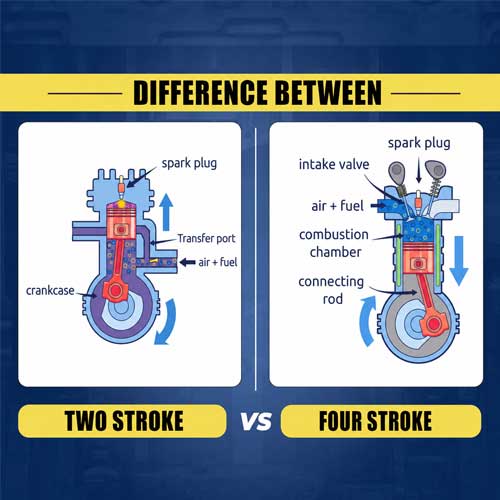
A 4-stroke engine, also known as a four-cycle engine, completes one combustion cycle through four separate piston movements. A motorcycle engine that completes intake, compression, combustion, and exhaust as four distinct stages.
Compared with a 2-stroke engine, a 4-stroke motor typically has a more complex valve system. It commonly uses intake and exhaust valves, a camshaft, a timing mechanism, and a separate engine oil lubrication system.
Because fuel and engine oil are stored separately, most 4-stroke dirt bikes do not require the rider to mix gasoline with oil before filling the fuel tank.
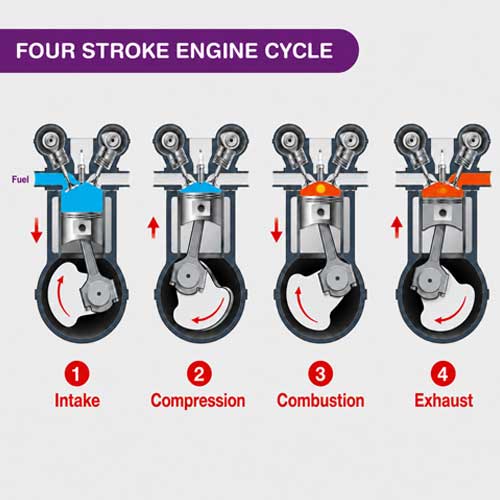
The four strokes are:
1. Intake stroke
2. Compression stroke
3. Power stroke
4. Exhaust stroke
During the intake stroke, the intake valve opens, and the piston moves downward. This draws the air-fuel mixture into the combustion chamber.
The intake valve closes, and the piston moves upward. The air-fuel mixture is compressed inside the cylinder.
Compressing the mixture allows it to burn more effectively when it is ignited.
Near the top of the compression stroke, the spark plug ignites the compressed mixture. The resulting combustion forces the piston downward.
This is the stroke that produces usable engine power.
The exhaust valve opens, and the piston moves upward again, pushing the burned gases out of the cylinder and into the exhaust system.
After the exhaust stroke, the cycle begins again.
A complete four-stroke cycle requires four piston movements and two crankshaft revolutions.
A four-stroke dirt bike normally produces smooth, predictable power across a relatively broad engine-speed range. Instead of waiting for a sharp burst of power at higher rpm, the rider can often access useful torque at lower speeds.
This characteristic can make a 4-stroke dirt bike easier to control when:
Four-stroke engines also produce more noticeable engine braking. When the rider releases the throttle, the motorcycle slows down more strongly without relying entirely on the brakes.
This can help on descents, although new riders may need time to become familiar with the sensation.
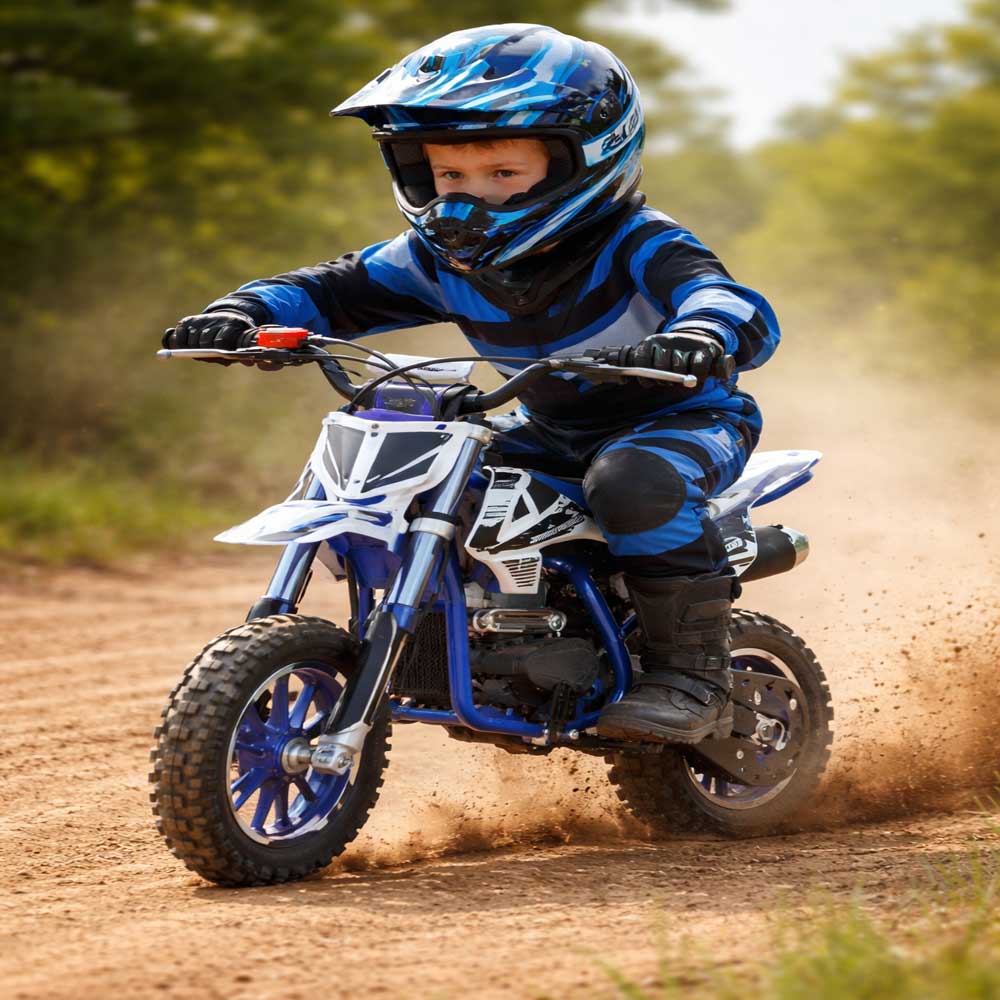
For younger riders, a compact four-stroke model can offer a more manageable introduction to off-road riding.The PCK-06 50cc 4-stroke kids dirt bike uses a 50cc air-cooled four-stroke engine and a fully automatic transmission. No manual clutch or gear is shifting for the rider to manage.
Its important features include:
Because the fuel and engine oil are stored separately, the rider does not need to prepare a gasoline-and-oil premix before every refill.
This convenience, together with smoother power delivery and an automatic transmission, makes a small 4-stroke platform worth considering for younger beginners.
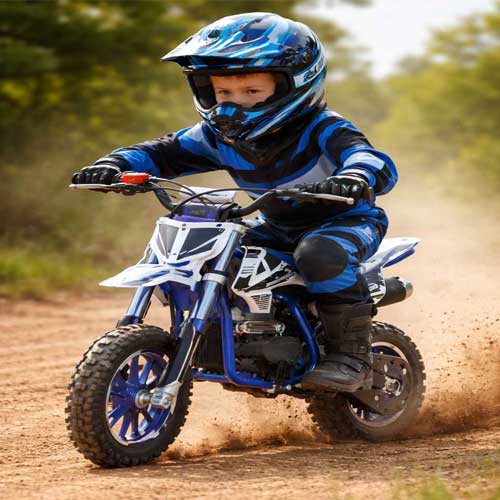
A 2-stroke engine completes its power cycle in two piston movements and one crankshaft revolution.
The engine combines the intake, compression, combustion, and exhaust processes into a shorter cycle than a four-stroke engine. This allows it to produce a power stroke during every crankshaft revolution.
The simpler design generally uses fewer moving engine parts. Most traditional 2-stroke dirt bike engines do not need the same intake valves, exhaust valves, camshaft, and valve-timing components found in a four-stroke engine.
As a result, 2-stroke engines are often:
However, many 2-stroke engines require gasoline to be mixed with specialized two-stroke oil. The correct ratio depends on the engine manufacturer.
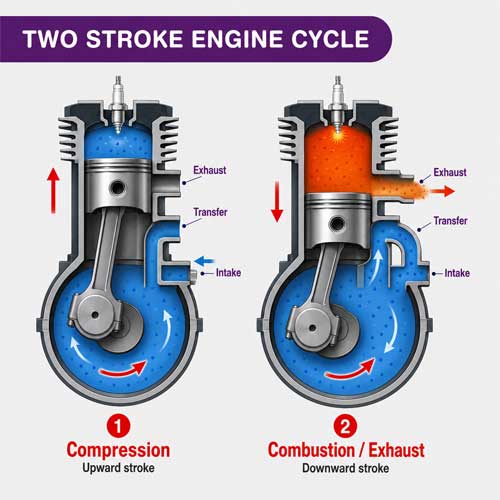
A 2-stroke engine completes its cycle through two primary piston movements.
As the piston moves upward, it compresses the air-fuel mixture in the combustion chamber. At the same time, a fresh mixture is drawn into another part of the engine.Near the top of the stroke, the spark plug ignites the compressed mixture.
Combustion pushes the piston downward and produces power. As the piston continues moving, exhaust gases leave the cylinder and a fresh air-fuel mixture enters.The cycle then repeats.
Because the engine produces a power stroke with every crankshaft revolution, a 2 stroke engine can provide a strong power-to-weight ratio.
The term “power band” describes the engine-speed range in which a dirt bike produces its strongest power.
Some 2-stroke dirt bikes feel relatively mild at low rpm and then deliver a stronger surge as the engine enters its most effective rpm range. Riders often describe this as “hitting the power band.”
However, not every 2-stroke engine behaves in the same way.
A small automatic 49cc kids dirt bike may be tuned for more manageable power, while a competition-focused motocross bike can deliver a much sharper response. Engine displacement, exhaust design, carburetor tuning, ignition timing, gearing, and rider weight all affect how the power feels.
The PCA-01 49cc kids dirt bike is an example of a compact two-stroke platform designed for younger riders.
The automatic transmission reduces the number of controls a beginner needs to manage. However, the fuel must be prepared using the manufacturer’s specified gasoline-to-oil ratio.
A 25:1 ratio is suitable for this particular model, but it should not be treated as a universal ratio for every 2-stroke engine.
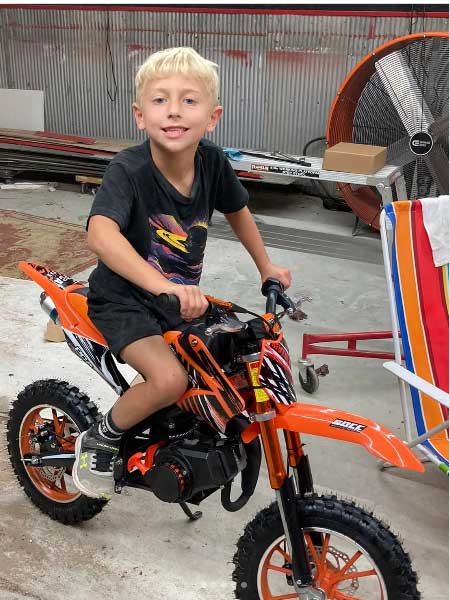
| Feature | 2 Stroke Dirt Bike | 4 Stroke Dirt Bike |
|---|---|---|
| Power cycle | One power stroke per crankshaft revolution | One power stroke every two crankshaft revolutions |
| Engine design | Simpler, with fewer moving parts | More complex valve and timing system |
| Power delivery | Quick and responsive | Smooth and predictable |
| Weight | Usually lighter | Usually heavier |
| Low-speed torque | Depends heavily on tuning | Generally stronger and easier to control |
| Engine braking | Relatively light | More noticeable |
| Lubrication | Often uses premixed fuel and oil | Uses a separate engine-oil system |
| Fuel economy | Often uses more fuel | Usually more fuel-efficient |
| Top-end maintenance | Often simpler | More complex due to valves and timing parts |
| Major repair cost | Commonly lower | Commonly higher |
| Typical appeal | Lightweight handling and lively response | Controlled power and broad torque |
| Beginner suitability | Depends on tuning and bike size | Often easier for beginners |
These are general characteristics rather than absolute rules. Modern engine design can significantly change how an individual motorcycle performs.
The most important differences are not limited to the number of piston strokes. Riders will also notice differences in power, handling, maintenance, fuel preparation, sound, and engine braking.
A 2-stroke dirt bike usually responds quickly when the throttle is opened. Competition-oriented models may deliver a noticeable surge at higher rpm.
A 4-stroke dirt bike normally builds power more progressively. Its wider torque range can make it easier to maintain traction on loose or uneven ground.
For beginner riders, predictable power is often more useful than peak horsepower.
Four-stroke engines are commonly known for usable low-rpm torque. This allows the motorcycle to move through slower terrain without requiring the rider to keep the engine at very high rpm.
A 2-stroke engine may require more careful throttle control and rpm management, although modern trail-focused two-stroke engines can also produce effective low-speed torque.
A 2-stroke engine normally contains fewer major moving parts. This can reduce engine weight and overall motorcycle weight.
A lighter dirt bike may be easier to:
Four-stroke dirt bikes are often heavier, but the additional weight may contribute to a planted, stable feel in some riding situations.
Engine braking is the slowing force produced when the rider closes the throttle.
Four-stroke dirt bikes usually have stronger engine braking. This can help control speed on descents and when entering corners.
Two-stroke dirt bikes provide less engine braking, so riders may depend more heavily on the front and rear brakes.
Neither characteristic is universally better. It is primarily a matter of terrain and rider preference.
Many 2-stroke engines require gasoline and two-stroke oil to be mixed at a specific ratio. Common ratios vary, so riders must follow the instructions for the exact engine.
Using too little oil may reduce lubrication and cause engine damage. Using too much oil can affect combustion, produce excessive smoke, and contribute to carbon buildup.
A four-stroke engine stores gasoline in the fuel tank and engine oil in a separate lubrication system. The two fluids are not normally mixed.
Although a 4-stroke engine does not require premixed fuel, its engine oil still needs to be checked and changed at the recommended intervals.
Four-stroke engines are generally more fuel-efficient because the combustion and exhaust processes are more completely separated.
Traditional 2-stroke engines can allow some unburned mixture to leave the cylinder during the scavenging process. Actual fuel use, however, depends on engine design, riding speed, terrain, load, maintenance, and throttle behavior.
Two-stroke engines typically produce a sharper and higher-pitched exhaust note.
Four-stroke engines normally produce a deeper, lower-frequency sound.
Noise levels vary between models, exhaust systems, and operating conditions. Riders should always comply with local noise rules and riding-area restrictions.
A 2-stroke top end usually contains fewer components. Replacing the piston and rings may therefore be simpler than repairing a four-stroke cylinder head.
However, a high-performance 2-stroke may require more frequent top-end inspection.
A four-stroke engine may operate for longer intervals between certain internal repairs, but its valve train, camshaft, timing chain, and related components can make major repairs more involved.
A 2-stroke dirt bike may be the better choice when low weight and quick response are priorities.
Its main advantages include:
Potential disadvantages include:
The main advantages of a 4-stroke include:
Potential disadvantages include:
So, is a 2-stroke or a 4-stroke better for off-road riding?
A 2-stroke is often better for riders who prioritize:
A 4-stroke is often better for riders who prioritize:
The answer also changes according to the rider’s experience and the type of terrain.
A small four-stroke is often easier for a new rider because its power is generally smoother and more predictable.
Beginners may find it easier to:
However, the engine cycle is only one part of beginner suitability.
A properly sized automatic 2 stroke can also work for a beginner, especially when it has manageable power delivery and a low seat height.
When choosing a beginner dirt bike, consider:
For children, a smaller and correctly fitted bike is generally more appropriate than an oversized motorcycle with a milder engine.
There is no single winner in the 2 stroke vs 4 stroke dirt bike comparison.
A 2 stroke is usually lighter, more responsive, and mechanically simpler, while a 4 stroke generally offers smoother power, stronger low-end torque, better fuel economy, and more predictable control.
For beginners, a small automatic 4 stroke is often easier to ride. Riders who prefer lower weight and quicker throttle response may prefer a 2 stroke.
The best choice depends on the rider’s experience, bike size, maintenance preferences, and intended use.
Smart + removable battery + gear-reduction torque = highest global demand
Fill out the form below, and we will be in touch shortly.